
More load than a shift can absorb
The alarm rate per operator exceeds the ISA-18.2 recommended limit, and the shift starts acknowledging without analyzing.

Alarm management
Alarms that guide the operator's action instead of competing for attention
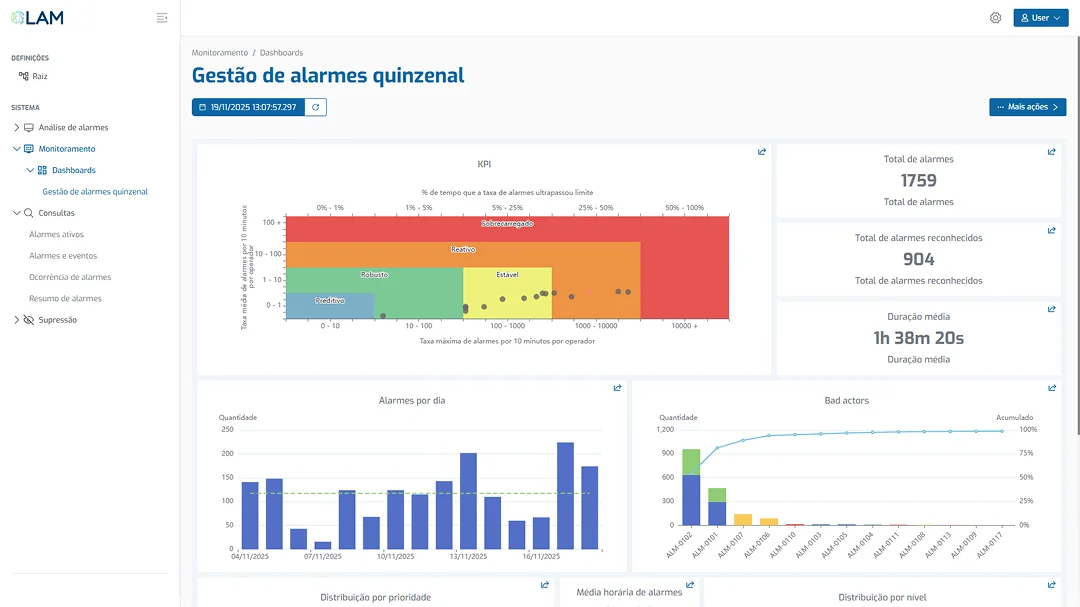
LAM structures alarm management in line with ISA-18.2: it measures the operator's actual alarm load, exposes the alarms that consume the most attention and turns your system history into a rationalization plan with defined priorities.
Aligned with ISA-18.2, IEC 62682 and EEMUA 191 best practices
The problem
In plants with a long history of expansions, the alarm system grows without review. The consequence shows up on shift: too many events, constant repetition and loss of trust in the information.
The alarm rate per operator exceeds the ISA-18.2 recommended limit, and the shift starts acknowledging without analyzing.
Repeating and chattering alarms concentrate the volume and hide the events that genuinely require intervention.
When almost every alarm is high priority, the classification no longer helps decide what to respond to first.
Rationalization happens informally, with no traceability of who changed what, when and on what grounds.
The contrast
Maturity
Conceptual reading of alarm management maturity stages. The highlight follows the simulation state as a contextual visual indicator, not as a normative classification.
The operator receives more alarms than can be interpreted and acknowledgement becomes mechanical.
Characteristics
To move forward
Measure real alarm behaviour and act on the few offenders that create most of the volume.
Interactive scenario
Increase the alarm rate and experience how volume, repetition and avalanches affect the operator's ability to keep up. Measuring alarm system performance is essential to identify overload, recurring patterns and the events that consume the most attention.
Single control for the simulation: both views use the events generated here. Time is accelerated 60× for this demonstration.
6
alarm/h
Manageable
Event console
Unacknowledged: 0
Alarms arriving as the operator receives them, with no analytical layer.
Illustrative scenario with simulated data representing different load conditions of an alarm system.
Related technical references: ANSI/ISA-18.2 – Management of Alarm Systems for the Process Industries · IEC 62682 – Management of Alarm Systems for the Process Industries · EEMUA 191 – Alarm Systems: A Guide to Design, Management and Procurement
Technical heritage
LAM comes from combining field experience in industrial automation with software engineering applied to process data — trajectories built by RN Tecnologia and Logique Sistemas before they formed IDUS.
That combination is what makes it possible to treat alarms as an operational problem rather than a system setting: the same team understands the control logic, the process behavior and the data that supports the decision.
The assessment uses the history of your own system to measure load per operator, identify the main sources and outline the rationalization plan.
Talk to the IDUS team and find out how digital platforms, automation and consulting can support your industrial operation.
Talk to a specialist